
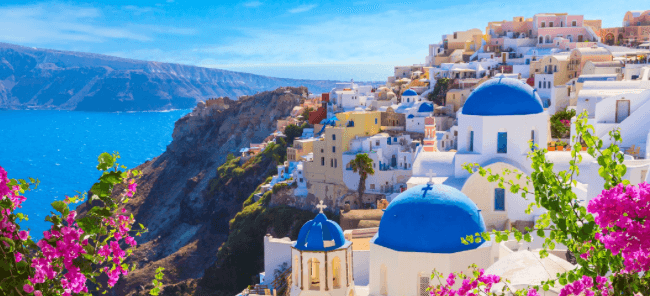

Greece country guide
Greece Property Guide
Buying, living and investing in Greece
Greece has always been easy to fall in love with. The difference now is that a lot more international buyers have actually bought there. Athens has recovered dramatically since the financial crisis, the famous islands have become serious international property markets, and the Golden Visa continues to attract buyers looking for European residency as well as somewhere in the sun.
But Greece isn't just Mykonos and Santorini. The Peloponnese, Crete, Halkidiki, smaller islands and mainland towns can offer completely different value. Even within Athens, an ordinary city apartment and a new property on the Athens Riviera barely feel like they're in the same market.
The bargain years haven't completely disappeared, but they're certainly harder to find. Mykonos isn't really priced by the square metre anymore. It's priced by the sunset.
Can foreigners buy property in Greece?
Yes. Foreigners can generally buy Greek property directly in their own name with full ownership rights.
You'll need a Greek tax number — AFM — and purchases normally involve a lawyer, notary and registration with the Greek Cadastre or relevant land registry.
There can be additional restrictions around certain border or strategically sensitive areas, so don't assume every piece of Greek land is automatically available to every foreign buyer.
More importantly, old properties and island homes can occasionally have complicated ownership histories, boundaries or planning issues.
Use an independent Greek lawyer and check the title properly.
Buy the view after you've checked who actually owns the ground underneath it.
Power-of-attorney purchases are also common, which can make buying from overseas considerably easier once your legal team is established.
Can foreigners live in Greece if they buy property?
EU and EEA citizens have relatively straightforward rights to live and work in Greece.
Non-EU nationals need an appropriate residence status for longer stays. Greece offers several routes, including work, family, financially independent residence and options for qualifying remote workers.
Then there's the one Greece has become particularly famous for: the Golden Visa.
Greece's property-linked Golden Visa remains available, but the investment threshold now depends heavily on where and what you buy.
In the highest-demand areas — including Attica, Thessaloniki, Mykonos, Santorini and certain larger islands — the standard property threshold can reach €800,000.
In many other parts of Greece, the threshold is €400,000.
There are also specific routes starting around €250,000 involving qualifying conversions or restoration of certain protected buildings, subject to detailed conditions.
Golden Visa rules have changed several times, particularly around property type and short-term rentals, so if residency is part of your reason for buying, check the exact current requirements before choosing the property.
Don't buy an €800,000 apartment because somebody told you it comes with a visa. Choose the right property and make sure it qualifies before you transfer the money.
How much does property cost in Greece?
This is where asking prices and actual selling prices become important.
Online asking prices nationally can average somewhere around €2,500 per square metre, but actual recorded transactions can be considerably lower.
That's worth remembering when negotiating.
Central Athens can range enormously, broadly from around €2,000 per square metre in more ordinary areas to €5,000, €6,000 or €7,000+ in premium neighbourhoods and high-quality developments.
Then you've got the Athens Riviera — Glyfada, Voula and Vouliagmeni — where desirable property can easily run from around €3,500 per square metre into five figures.
Mykonos and Santorini are another world entirely.
Move into parts of the mainland or Peloponnese and prices can become considerably more approachable, sometimes around €1,400–€3,000 per square metre depending on location and proximity to the coast.
This is why Greece still has opportunities.
Don't search for “Greek property”. Search for the Greece you actually want to live in.
What are rental yields in Greece?
Long-term gross rental yields can broadly sit around 4–5% nationally, with some parts of Athens and Piraeus capable of producing higher returns.
Well-bought city apartments can sometimes reach 6–7% gross, while parts of the Athens Riviera can sit somewhere around 5–6%.
Holiday rentals are where you'll see the bigger numbers.
In strong tourist areas, gross short-term rental returns of 6–10% can appear achievable on paper.
But Greece has the same problem as every beautiful seasonal market.
July isn't February.
A villa that's booked continuously during summer can spend large parts of winter doing absolutely nothing.
Once you've deducted management, cleaning, utilities, maintenance, platform fees, tax, insurance and annual property costs, net returns can fall considerably.
Never calculate an island investment using August occupancy twelve times.
And if you're buying through a Golden Visa route, check whether short-term letting is actually permitted for your particular property and residence structure.
How much does it cost to buy property in Greece?
As a broad starting point, budget around 6–10% above the purchase price for a normal transaction.
The standard property-transfer tax is around 3%, with associated municipal charges taking the effective figure slightly higher.
You'll also need to allow for notary fees, lawyer fees, registration and potentially estate-agent commission. Agents commonly charge around 2% plus VAT per side, although arrangements vary.
Greece also has an annual property tax called ENFIA. It's generally manageable compared with property taxes in some countries, but it still needs to go into your ownership calculation.
VAT treatment on new-build property has been subject to temporary measures and extensions, so check the position applying to the particular property and transaction rather than relying on an old article online.
Tax policy affecting foreign property buyers can also change.
The tax figure that applied when you first bookmarked the villa isn't necessarily the tax figure you'll pay when you buy it.
How easy is it to sell property in Greece?
Greece has a functioning resale market, particularly in Athens, Thessaloniki, Crete and the better-known islands.
Once you've found a buyer and the property's legal file is clean, the formal transaction can sometimes complete within one to two months.
Finding the buyer can take considerably longer.
A desirable Athens apartment has a completely different buyer pool from an unusual stone house on a quiet island.
Island property is also naturally seasonal. Buyers tend to become considerably more interested in owning somewhere beside the Aegean when they're actually looking at the Aegean.
August itself isn't necessarily when you want to complete anything.
August is when Greece goes swimming.
Capital-gains tax treatment on individual property sales has been suspended for extended periods, but because those rules have repeatedly changed, check the position applying in the year you actually sell.
What's it actually like living in Greece?
The Greece you experience on a two-week holiday isn't necessarily the Greece you'll experience in January.
Athens is a genuine European capital — busy, noisy, historic, chaotic in places and increasingly international.
Thessaloniki has its own identity and a strong year-round population.
Crete is almost big enough to behave like a small country, with proper cities, hospitals, universities, mountains, beaches and communities that continue functioning when the tourists leave.
Then you've got hundreds of islands.
Some remain active throughout winter.
Others almost switch themselves off.
That isn't necessarily bad. A quiet Greek island in winter can be fantastic if that's the life you want.
But find out before buying.
Visit your Greek island when the ferry is late, the taverna is closed and nobody has put the sunbeds out. If you still love it, you're probably onto something.
Weather
The brochure isn't lying.
Greek summers are generally hot, dry and sunny, particularly across the southern mainland and islands.
Winters are milder around the southern coast and islands, although Greece can become much colder than first-time visitors expect.
Athens in August can be brutally hot.
Wildfires are also a genuine summer risk in certain parts of the country and should be considered when buying rural or heavily wooded property.
Spring and autumn are often the periods when Greece is at its best — warm enough to enjoy the coast without spending the entire day looking for air conditioning.
Food
Greek food doesn't need much selling.
Good tomatoes actually taste like tomatoes. Feta isn't something sprinkled over a salad from a plastic tub. Fresh fish arrives grilled rather than redesigned.
You've got souvlaki, moussaka, grilled octopus, lamb, village salads, local cheeses, olive oil and regional dishes that change as you travel.
Then there's the Greek taverna.
A table beside the sea, food appearing gradually and absolutely nobody looking remotely interested in turning the table for the next booking.
Coffee can take forty minutes.
Lunch can accidentally become dinner.
You'll adapt.
Things to do
You could spend years simply working through the Greek islands until you decide which one is your favourite.
The Peloponnese is fantastic for road trips, beaches, ancient sites and finding coastal areas that haven't reached Mykonos pricing.
Crete gives you an island lifestyle without necessarily sacrificing cities, hospitals and year-round infrastructure.
Athens gives you the Acropolis, museums, restaurants and enough history to make almost anywhere else feel recently constructed.
Then there are places such as Corfu, Rhodes, Zakynthos, Paros, Naxos and countless smaller islands, each with a completely different character.
The difficulty isn't finding somewhere beautiful.
It's deciding which beautiful place you could actually live in.
Schools
Greek public schools are free and teaching is primarily in Greek.
International and English-language schools are concentrated mainly around Athens and other major population centres.
Families considering permanent island life need to investigate education particularly carefully.
An island might have the perfect house and beach but absolutely none of the schooling options your children need.
That's not something to discover after you've completed.
Healthcare
Athens and Thessaloniki have good public and private hospitals, while larger islands such as Crete also have substantial healthcare infrastructure.
Smaller islands are a different matter.
Some have perfectly adequate local hospitals or clinics for everyday care. Others rely on transfers to larger islands or the mainland for serious treatment.
If you're buying somewhere remote for retirement, find out exactly what happens if you need urgent specialist care at 2am in February.
Private health insurance and medical-evacuation cover can make sense for people living on smaller islands.
That's not being dramatic.
Island life is wonderful until you urgently need something the island doesn't have.
Is Greece safe?
Generally, Greece is considered a relatively safe destination for international residents and visitors.
Violent crime against tourists is uncommon. In Athens, the more familiar problem is pickpocketing around crowded tourist areas and public transport.
Strikes and demonstrations occasionally disrupt transport and services.
For property owners, summer wildfires can be a more relevant concern than crime in certain rural areas.
And then there are Greek roads.
Depending on where you're driving, they may test your nerves considerably more than the local criminals.
In many smaller villages, evenings remain remarkably quiet.
A dog, three people outside the café and somebody who already knows you're looking at the house before you've told anyone.
That's village Greece.
So, is Greece a good place to buy property?
For the right buyer, absolutely. Greece combines EU ownership, the euro, Mediterranean lifestyle, a huge tourism industry and one of Europe's best-known property-linked residency programmes.
But don't assume every Greek island is an investment.
Athens can offer genuine year-round rental demand. The Athens Riviera is increasingly international and expensive. The Peloponnese can provide much more property for your money. Crete offers an excellent compromise between island life and proper infrastructure. Mykonos and Santorini are global luxury markets with prices to match.
If the Golden Visa matters to you, start with the current qualifying rules before searching for property.
If rental income matters, calculate February as well as August.
And if you're buying an old island house, pay somebody competent to check the title, boundaries and planning history.
Greece is very good at making you fall in love with a view.
Your lawyer's job is to make sure you can actually own it.
Frequently asked questions about buying property in Greece
Can foreigners buy property in Greece?
Yes. Foreigners can generally buy and own Greek property directly, although additional permission can apply in certain border or strategically sensitive areas.
How much does property cost in Greece?
Prices vary enormously. Parts of the mainland and Peloponnese can remain relatively affordable, while prime Athens Riviera property and famous islands such as Mykonos and Santorini can command several thousand euros per square metre.
Can buying property in Greece give me residency?
Qualifying non-EU buyers may obtain residency through Greece's Golden Visa programme. Property thresholds vary by location and property type, so current eligibility should be checked before purchasing.
What are typical rental yields in Greece?
Long-term gross yields are commonly around 4–5%, with higher returns possible in parts of Athens and Piraeus. Holiday rentals can show higher gross returns but are much more seasonal.
Where is the best place to buy property in Greece?
It depends on the reason for buying. Athens suits year-round rental demand, the Athens Riviera offers a premium coastal market, Crete combines island life with infrastructure, the Peloponnese can offer better value, while famous islands generally carry substantially higher prices.