

Guide pays : Spain
Spain Property Guide
Buying, living and investing in Spain
Spain doesn't really need introducing to international property buyers.
British buyers have been buying there for generations, northern Europeans have followed them south, and today foreign buyers account for a meaningful share of Spanish property transactions.
But the Spain people buy isn't one market.
Costa del Sol is the brochure. Alicante and the Costa Blanca are enormous international-buyer markets. Valencia combines city life with the Mediterranean. Madrid is a proper European capital. Barcelona is Barcelona. And travel inland and suddenly the same money buys an entirely different house.
Spain uses the euro, has an established land-registration and notary system and allows foreigners to own property directly.
The old property Golden Visa is gone.
The NIE definitely isn't.
Can foreigners buy property in Spain?
Yes. Foreigners can generally buy Spanish property directly with full ownership rights.
You don't need a Spanish partner or special company.
You will need an NIE — Número de Identidad de Extranjero — your foreigner's identification number.
It's one of those bits of Spanish administration you'll become familiar with surprisingly quickly.
Use an independent Spanish lawyer to investigate the property before completing.
They should check the nota simple from the Land Registry, ownership, debts, planning status, community charges and whether alterations to the property have been legally registered.
That last one matters.
The villa may clearly have four bedrooms and a swimming pool.
The paperwork may remember a time when it had three bedrooms and a field.
Buy what's legally registered, not simply what's visible from the terrace.
For off-plan purchases, make sure deposits have the appropriate protection and bank guarantees.
Spain has a mature legal property system.
Use it properly.
Can foreigners live in Spain if they buy property?
Buying Spanish property and obtaining Spanish residency are separate things.
EU and EEA citizens have relatively straightforward rights to live and work in Spain, subject to the usual registration requirements.
Non-EU citizens need the appropriate visa or residence permit.
Spain has routes for workers, families, students, financially self-sufficient residents and remote workers.
The non-lucrative visa remains popular with retirees and people who can support themselves without working locally.
Spain also has a digital nomad visa for qualifying remote workers.
Income requirements are linked to official Spanish financial measures and can change, so check the current threshold when applying rather than relying on last year's figure.
Spain's property Golden Visa closed to new applications in April 2025.
So if you find a Marbella listing still telling you that buying a €500,000 villa automatically qualifies you for a Golden Visa, you're reading an old advert.
The villa can still be lovely. The visa left without it.
How much does property cost in Spain?
Spanish property prices have continued rising, but national averages aren't particularly useful unless you understand the enormous regional differences behind them.
Broad national transaction measures can sit somewhere around €2,000–€2,500 per square metre.
That includes Madrid, Barcelona and the Balearics at one end and inexpensive inland provinces at the other.
In parts of inland Spain, property can still be found below €1,000 per square metre.
Then head towards the international coast and everything changes.
Foreign buyers naturally pay more on average because they're disproportionately purchasing around Alicante, Málaga, the Balearic Islands, Canary Islands and other coastal markets.
Alicante in particular has an enormous international property market.
The Costa del Sol around Málaga and Marbella sits much further towards the premium end.
Madrid and Barcelona operate as major international cities rather than simply Spanish lifestyle destinations.
And Valencia has become increasingly interesting because it combines a major city, beaches and international connections without automatically carrying Madrid or Barcelona pricing.
Don't ask what property costs in Spain.
Ask what it costs in the part of Spain where you'd actually live.
What are rental yields in Spain?
Spain can offer respectable rental returns, particularly outside the most expensive resort and prime-city markets.
Gross apartment yields around 5–6% can be achievable in a number of cities, while places such as Valencia and Murcia can sometimes look particularly attractive on the relationship between purchase price and rent.
Prime Marbella and Palma naturally tend to produce lower percentage yields because the properties themselves are expensive.
Madrid and Barcelona need analysing neighbourhood by neighbourhood.
Holiday rentals are another matter.
Spain's autonomous communities and individual municipalities have their own rules, licences and restrictions.
Don't assume that because the apartment above yours is on Airbnb, yours automatically can be too.
This is particularly important in Barcelona, the Balearics and other heavily regulated tourism markets.
The beach doesn't come with a holiday-let licence.
If rental income matters, check the legal rental position before buying rather than afterwards.
How much does it cost to buy property in Spain?
Spanish buying costs are significant.
As a broad rule, allow around 10–14% above the purchase price, depending on the region and whether you're buying a resale or new-build property.
For resale property, the main tax is ITP — transfer tax.
The rate varies by autonomous community and can broadly range from around 6% into double digits.
Madrid can be towards the lower end.
Andalucía has its own rates.
The Valencia region can be higher.
Catalonia and the Balearics can become particularly expensive at higher property values.
For new-build residential property, buyers generally pay 10% IVA — VAT — plus AJD stamp duty, rather than ITP.
Then add notary, Land Registry, lawyer and administration costs.
This regional variation is something international buyers sometimes underestimate.
A €300,000 house in Madrid and a €300,000 house in Valencia don't necessarily cost the same amount to buy.
Spain has one flag and several different answers to “how much is the tax?”
Get the actual calculation for the property and region before signing.
What does it cost to own property in Spain?
Property owners generally pay annual IBI, the municipal property tax.
The amount depends on the property's cadastral value and local authority.
If you're buying inside an apartment building or urbanisation, you'll probably also have comunidad fees covering shared facilities, gardens, security, lifts and swimming pools.
Ask to see the community accounts.
The huge pool, beautifully maintained gardens and 24-hour security are lovely.
Somebody is paying for them.
If you're a non-resident owner, Spain can also impose tax obligations even if you don't permanently live there.
Rental income has its own non-resident tax treatment, and second homes that aren't rented can potentially attract imputed income tax.
That's the one that surprises people.
Spain can tax the imaginary rent on a house you didn't actually rent.
Welcome to Spanish property ownership.
How easy is it to sell property in Spain?
Spain has one of Europe's deepest international property markets.
That's a genuine advantage.
The Mediterranean coast has Spanish buyers, British buyers, Germans, Dutch, Scandinavians, French and many other nationalities all looking at overlapping markets.
A sensibly priced property around Alicante, Málaga or another established coastal destination therefore has a substantial potential audience.
Madrid, Barcelona and Valencia naturally have deep domestic markets as well.
Move into a small inland village and the picture changes.
You may get far more house for your money, but there are fewer people waiting to buy it from you.
Once you've agreed a sale and the legal file is clean, completion can often take roughly six to ten weeks, although every transaction is different.
Seller costs commonly include estate-agent commission around 3–5% plus VAT, potential capital-gains tax and the municipal plusvalía tax.
Non-resident sellers can also face withholding against their potential tax liability.
The easiest Spanish property to sell is normally the one somebody else immediately understands why you bought.
Location still wins.
What's it actually like living in Spain?
This depends enormously on where you go.
The Costa del Sol has one of Europe's most established international communities. In some places, you can live surprisingly easily without much Spanish.
The Costa Blanca and Alicante region have enormous British and northern-European populations.
Valencia gives you a genuine Spanish city, beaches, culture and comparatively approachable costs.
Madrid is a major capital with everything that implies.
Barcelona combines international city life with the Mediterranean, although housing costs and tourism pressures are significant.
Then there are places such as Murcia, inland Andalucía, Extremadura, Galicia, Asturias and northern Spain where everyday life can feel completely removed from the expat costas.
That's why I'd always tell somebody considering Spain:
Don't decide you want to live in Spain. Decide which Spain you want to live in.
The difference matters enormously.
Weather
The Spanish weather stereotype is both correct and completely wrong.
The Mediterranean coast gives you the mild winters and hot summers most international buyers expect.
The north — including Galicia, Asturias and the Basque Country — is much greener because it rains considerably more.
Madrid and the central plateau have proper winters and extremely hot summers.
Andalucía can become brutally hot inland during July and August.
Then there are the Canary Islands, where the climate can feel like spring for most of the year.
If winter sun is the reason you're moving, visit in January.
If you've only seen inland Spain in April, visit in August before buying.
Spanish sunshine is wonderful. Spanish sunshine at 42°C is a different product.
Food
Food is part of everyday Spanish life rather than something reserved for special occasions.
And like the property market, it changes completely by region.
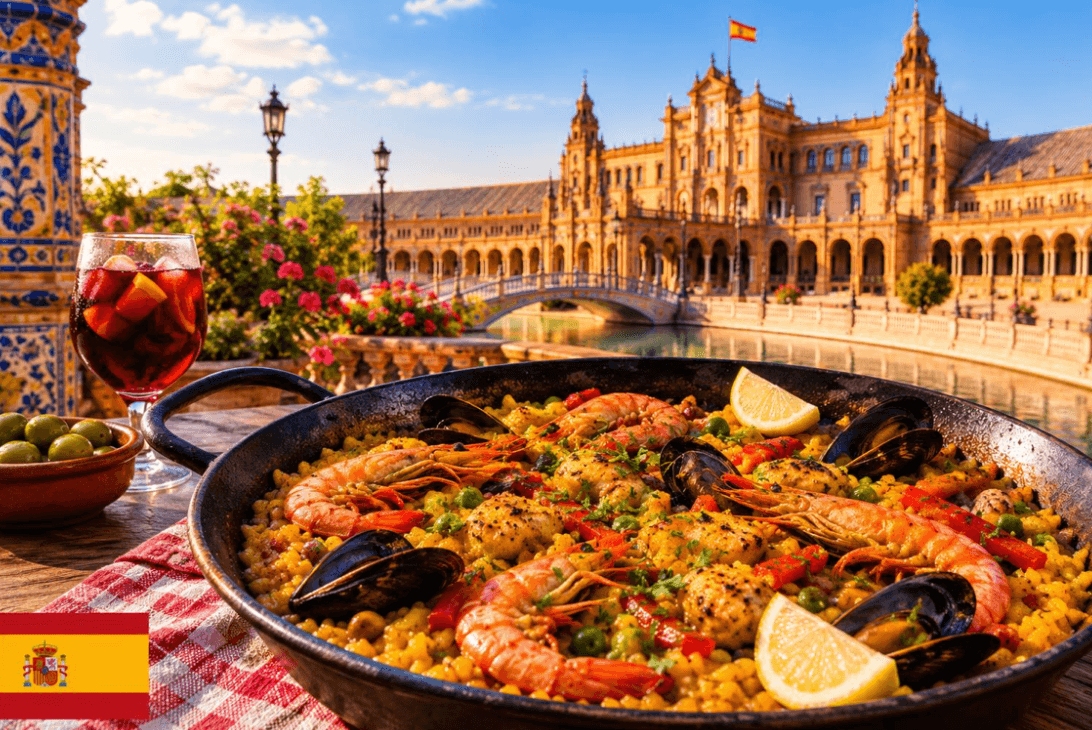
You've got jamón, olive oil, seafood on the coast, proper inland stews, pintxos in the north, paella in Valencia and regional dishes that Spaniards will happily explain you're eating incorrectly.
Lunch can start at two.
Dinner can start at a time when some northern Europeans are considering going to bed.
You'll adjust.
Wine can cost less than a sandwich in London.
You'll adjust to that remarkably quickly.
If you're moving permanently, learn to eat when Spain eats rather than spending ten years wondering why the restaurant is empty at six.
Things to do
Spain gives you an extraordinary amount of variety.
There are thousands of kilometres of coastline, historic cities, mountains, islands, national parks and some of Europe's best nightlife.
You've got Madrid, Barcelona, Valencia, Seville, Granada and Bilbao.
There's surfing in the north and west.
Walking the Camino de Santiago.
Skiing in the Sierra Nevada while somebody else is sitting on a beach around Málaga.
Then you've got Mallorca, Ibiza, Menorca and the Canary Islands.
Spain is one of those countries where owning a property can make sense simply because you could spend years exploring the rest of it.
And you'll still argue about which beach is best.
Schools
Spanish state education is free and generally good.
Teaching is naturally in Spanish, although regional languages such as Catalan, Basque and Galician can play a major role depending on where you live.
That deserves proper consideration before relocating children.
International and British-style schools are concentrated around Madrid, Barcelona, Valencia, Málaga, Marbella, Alicante and the islands.
Fees can be substantial.
If you're relocating permanently, local school can be one of the fastest ways for younger children to integrate.
Older children midway through GCSEs, A-levels or IB need more planning.
Choose the school before you choose the swimming pool.
The children will probably thank you eventually.
Healthcare
Spain has an excellent public healthcare system.
Eligible residents access the Sistema Nacional de Salud — SNS, generally through social-security entitlement or other qualifying arrangements.
Non-EU visa applicants often need private medical insurance initially.
Private healthcare is widely available and particularly strong around Madrid, Barcelona and the major coastal expat areas.
Many private hospitals on the Costa del Sol and Costa Blanca are very accustomed to international patients and English-speaking residents.
For retirees and long-term residents, healthcare is one of Spain's biggest advantages compared with many cheaper overseas property markets.
You don't need an evacuation plan because you've bought a villa two hours from the nearest specialist hospital.
That's worth something.
Is Spain safe?
Spain is generally a very safe country to live in.
Violent crime is relatively low.
The more common issues affecting visitors and international residents are pickpocketing, bag theft and opportunistic crime in crowded tourist areas.
Barcelona has a particular reputation for pickpocketing around busy tourist zones and public transport.
Madrid, Seville and other heavily visited cities have the same basic issue.
Outside the major tourism centres, many Spanish towns and villages feel extremely safe.
A village late at night may consist mainly of a dog, three chairs outside a bar and somebody's television coming through an open window.
Not exactly Gotham.
So, is Spain a good place to buy property?
Spain remains one of the strongest international property markets in Europe.
Foreigners can buy directly.
There's an established legal and banking system.
Healthcare is excellent.
The weather is a genuine lifestyle advantage.
And crucially, there is a large resale market made up of both Spanish and international buyers.
But Spain isn't one property market.
Marbella is not Murcia.
Madrid isn't Alicante.
Barcelona isn't inland Andalucía.
A €250,000 budget can buy a modest apartment in one place and a substantial house with land somewhere else.
The property Golden Visa may have gone, but for most people considering Spain as somewhere to actually live, it was never the most important reason anyway.
Buy Spain because you want Spain, not because you thought the house came with residency.
Then choose the region carefully.
Because finding the right part of Spain will probably matter considerably more than finding the right swimming pool.
Frequently asked questions about buying property in Spain
Can foreigners buy property in Spain?
Yes. Foreigners can generally buy Spanish property directly with full ownership rights. You'll normally need an NIE before completing the purchase.
How much does property cost in Spain?
National averages can sit around €2,000–€2,500 per m², but regional differences are enormous. Prime Madrid, Barcelona, Marbella and island markets can cost substantially more, while inland provinces can remain below €1,000 per m².
Can buying property in Spain give me residency?
No. Spain closed its property Golden Visa route to new applications in April 2025. Non-EU buyers need to qualify through another visa or residence route.
What are typical rental yields in Spain?
Gross residential yields around 5–6% can be achievable in various markets, with some cities higher and expensive resort locations lower. Holiday-rental rules vary significantly by region.
Where do foreigners buy property in Spain?
Alicante and the Costa Blanca, Málaga and the Costa del Sol, the Balearic and Canary Islands, Valencia, Murcia, Barcelona and Madrid all attract significant international demand, but each serves a very different type of buyer.