

Länderleitfaden Curaçao
Curaçao Property Guide
Buying, living and investing in Curaçao
Curaçao sits in the southern Caribbean, just off the coast of Venezuela and east of Aruba. It's part of the Kingdom of the Netherlands, but it has a personality completely of its own. Willemstad is colourful, historic and UNESCO-listed, while outside the city you've got beaches, diving, dry landscapes and a climate helped enormously by the trade winds.
You'll hear Papiamentu, Dutch and English, often in the same day. The currency is linked to the US dollar, foreigners can generally buy property without special restrictions, and the island sits outside the main Caribbean hurricane belt. That's quite an attractive combination.
It isn't the cheap Caribbean secret it might once have been, though. International money has already found Curaçao.
Can foreigners buy property in Curaçao?
Yes. Foreign buyers can generally purchase property with the same ownership rights as locals, without needing a local partner or special foreign-buyer licence.
There are two important ownership types to understand. Eigendom is full freehold ownership. Erfpacht is long leasehold, where you own the right to use the land for a long period rather than owning the land itself outright. Leasehold isn't automatically a problem, but check the remaining term, conditions and ground rent before buying.
Transactions go through a civil-law notary and are registered with the Kadaster, giving Curaçao a more structured property-transfer system than you'll find in some Caribbean markets. Non-residents can also complete transactions through power of attorney in appropriate circumstances.
The important bit is simple: understand whether you're buying freehold or leasehold before falling in love with the swimming pool.
Can you live in Curaçao if you buy property?
Buying a house doesn't automatically give you the right to live there permanently.
Many nationalities can visit Curaçao without obtaining a traditional visa in advance, although permitted stays depend on nationality and circumstances. Longer-term living requires the appropriate immigration status.
Dutch nationals and some other groups have different admission arrangements, while Curaçao also has residence routes connected with work, retirement and qualifying investment.
There is an investor residence programme where the length and type of permit can depend on how much you invest in Curaçao, including qualifying property or business investment. If residency is part of your reason for buying, confirm the current investment thresholds and conditions before committing yourself.
Buy the villa because you want the villa. Don't assume the keys automatically come with residency.
What does property cost?
Curaçao has become considerably more expensive in the areas international buyers tend to want.
The online market is also slightly misleading because luxury villas around Jan Thiel, Vista Royal, Blue Bay and Spanish Water pull the averages upwards.
Simple apartments can still start around US$150,000–$250,000, while decent apartments and smaller houses often move into the US$250,000–$400,000 range.
Move into established international areas and the numbers change quickly. Villas around Jan Thiel, Blue Bay and other resort locations can easily run from US$500,000 to well over US$1 million, with prime waterfront homes higher again.
Family homes outside the main resort belt can offer considerably better value.
And Curaçao has another little property-market characteristic worth knowing: not everything appears neatly on a big property portal. Some business still happens through local networks, agents and WhatsApp.
The house you're looking for might be online. It might also be sitting three streets away with somebody's cousin holding the keys.
What about rental returns?
Curaçao has both long-term and holiday-rental markets.
The holiday side naturally concentrates around places such as Jan Thiel, Mambo Beach, Blue Bay and other established tourist areas.
You'll see attractive gross-return claims — sometimes 7% or considerably higher — particularly on short-term holiday accommodation.
As always, gross isn't net.
Management, cleaning, utilities, insurance, maintenance, empty periods, tax and increasingly competitive holiday-rental supply all need to come out of that number.
A genuine mid-single-digit net return can be a perfectly respectable result. I'd rather see a property genuinely producing 5% after realistic costs than a brochure promising 12% before anyone has paid the cleaner.
Ask for actual booking history if you're buying an existing holiday rental.
Airbnb projections are interesting. Airbnb statements are better.
How much does buying cost?
Allow roughly 5–7% above the purchase price as a sensible starting point.
Property-transfer tax is generally around 4% of the purchase price or assessed value, whichever basis applies, with notary and registration costs on top.
New-build developments can be structured differently, particularly where properties are advertised on a costs-included basis, so check exactly what the advertised price includes.
Curaçao also has annual property taxation based on assessed value.
Compared with some Caribbean jurisdictions, the buying process is relatively structured because the notary handles the legal transfer and registration.
That doesn't mean you stop asking questions.
Notaries transfer property. You still need to understand what you're buying.
How easy is it to sell?
Curaçao has an established international property market, but it's still an island with a relatively small population.
Desirable, sensibly priced property in established areas can attract buyers reasonably well. Overpriced villas and unusual inland properties can sit considerably longer.
Once you've agreed a sale, the formal notarial transfer process might take roughly two to three months, but finding the buyer is the unpredictable part.
Agent commissions commonly fall somewhere around 3–5%, depending on the agreement.
One attraction for private property owners is that Curaçao generally doesn't impose a traditional capital-gains tax on the private sale of a home, although your own country of tax residence may have something to say about the profit.
Don't confuse “no local capital-gains tax” with “nobody can tax me”.
Tax authorities rarely share that sense of adventure.
What's it actually like living in Curaçao?
Curaçao isn't a tiny resort island where everyone lives inside the tourism industry.
Willemstad is a real city. People work, go to school, sit in traffic, shop, run businesses and live normal lives.
Then you've got the international and resort communities around places such as Jan Thiel and Blue Bay, where the lifestyle can feel considerably more European and tourism-focused.
The western side of the island becomes quieter, less developed and more local.
That variety is part of Curaçao's appeal.
It's also dry. If your idea of the Caribbean is dense green jungle, Curaçao might surprise you. The landscape is more rugged, cactus-filled and arid.
Personally, I'd see that as part of the character rather than a downside.
Weather
Curaçao is warm throughout the year, generally sitting somewhere around 27–30°C, with trade winds helping enormously.
Rainfall is relatively low, with the wetter period generally towards the end of the year.
The big advantage is location.
Curaçao sits outside the main Atlantic hurricane belt, so hurricanes aren't the annual concern they are on many Caribbean islands.
That doesn't mean weather can never affect the island, but it's a genuine advantage for homeowners, insurers and anyone who doesn't fancy spending every September staring at a storm-tracking app.
Food
Curaçao's food reflects the island itself: Caribbean, Dutch, Latin American and local influences all mixed together.
Try keshi yena, traditionally made with cheese stuffed with seasoned meat, along with goat, stews, fresh fish, pastechi and arepas.
Willemstad — particularly areas such as Pietermaai — has plenty of good restaurants, while local snack bars can often provide a much cheaper and more authentic meal.
And yes, there's Curaçao liqueur.
Do the tour once.
You don't need to build your property search around it.
Things to do
The beaches are an obvious starting point. Cas Abao, Playa Kenepa and Porto Mari are among the better-known ones, and the water around Curaçao is excellent for snorkelling and diving.
There's the famous Tugboat dive and snorkel site, Spanish Water for sailing and boating, and Christoffel National Park if you fancy discovering that Caribbean islands can involve hills as well as sun loungers.
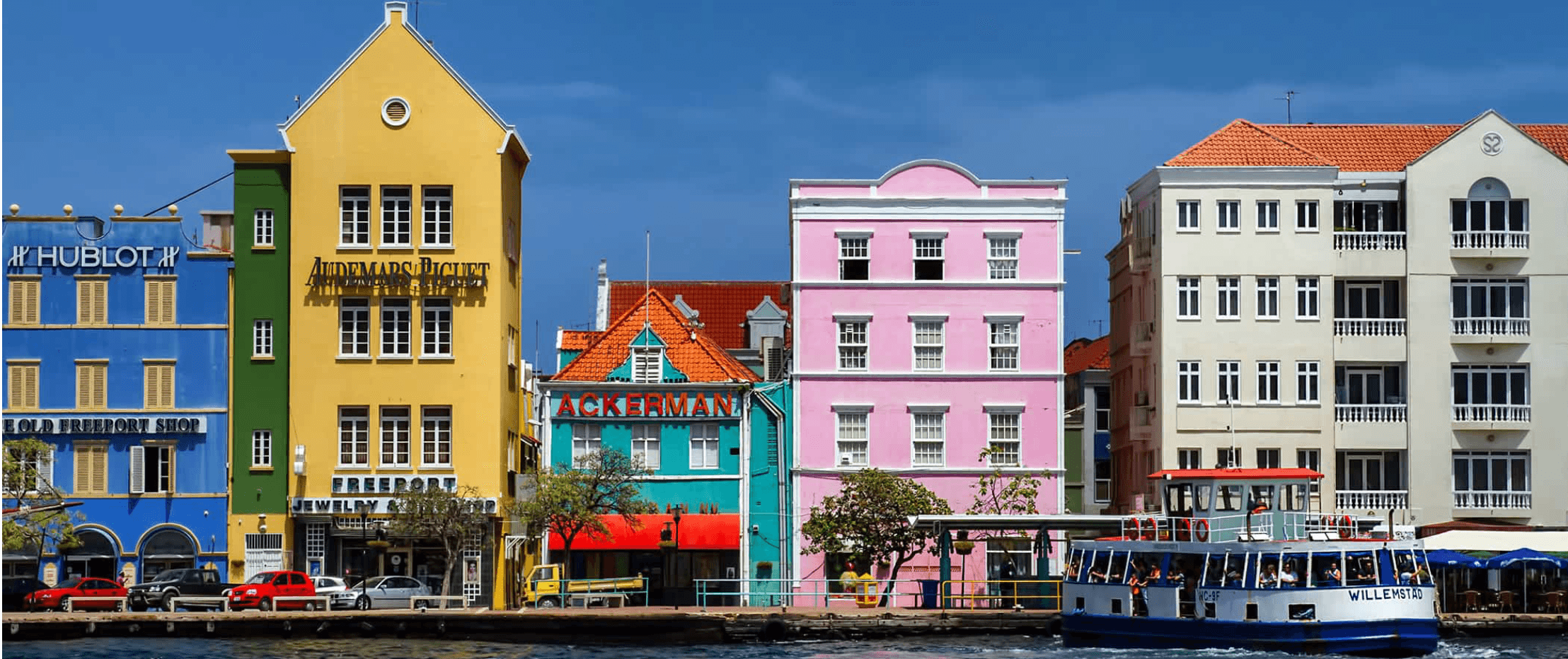
Then there's Willemstad itself. The colourful Handelskade waterfront is the postcard image, but the city becomes much more interesting once you start wandering around Punda, Otrobanda and Pietermaai.
Curaçao isn't somewhere where you need an enormous sightseeing checklist.
A lot of the lifestyle is simply beach, boat, dinner, breeze, repeat.
There are worse routines.
Schools
Curaçao's education system has strong Dutch influence, with Dutch and Papiamentu commonly used in schools.
For international families, language is therefore an important consideration.
There are private and international options, including the International School of Curaçao, alongside Dutch-language schools.
Choice is naturally smaller than in a major European or North American city, so families relocating with children should investigate schools before choosing where to live.
A twenty-minute drive to the beach is easy.
A difficult school situation every morning isn't.
Healthcare
Curaçao Medical Center in Willemstad is the island's main modern hospital and provides a good range of services.
Residents may participate in Curaçao's local healthcare insurance system depending on their status, while visitors and new arrivals should make sure they have appropriate private or international insurance.
For highly specialised or complex treatment, travelling abroad can still become necessary, with Colombia, the Netherlands and the United States among the possible destinations.
So healthcare is considerably stronger than on some smaller Caribbean islands, but international medical cover is still worth considering if you're relocating permanently.
Is Curaçao safe?
Generally, Curaçao is a relatively comfortable Caribbean destination for residents and visitors, but normal precautions still apply.
The more common problems are things such as theft from cars, burglary and opportunistic theft around beaches and tourist areas.
Don't leave your phone and wallet on the sand while you disappear into the sea for forty minutes. Don't leave bags visible inside the car. And understand the neighbourhood before buying simply because the villa has a nice gate.
Most people live perfectly normal lives here without constantly thinking about crime.
Common sense travels well.
So, does buying in Curaçao make sense?
For the right buyer, Curaçao has an interesting combination that's difficult to find elsewhere in the Caribbean: straightforward foreign ownership, a Dutch-style legal and notarial system, good international connections, warm weather and a location outside the main hurricane belt.
It's also a genuine place to live rather than simply a collection of holiday resorts.
But prices in the best-known areas have already risen substantially. Don't assume every villa makes a fantastic holiday rental, and don't assume you'll sell an expensive property in a few weeks simply because the market looks busy.
Understand freehold versus leasehold. Work out the real net rental return. Check your residency position separately. And look beyond Jan Thiel before deciding what Curaçao costs.
Curaçao isn't the undiscovered Caribbean anymore. Foreign buyers already found it.
The opportunity now is finding the right property at the right price — not pretending you're the first person to arrive.